

Menotto Group
Best areas to live in Cancún, based on how you want to live
This article helps you understand the best areas to live in Cancún based on how you want to live: if your week revolves around the hotel and the beach, a gated residential, or downtown daily life. If you are considering living in Cancún, the filter here is fit (work, family, trips), not a ranking of "top colonias" copied from an ad.
The comparison covers the Hotel Zone, Puerto Cancún and Cancún Centro. It also names, as types and not as a ranking, the Cancún residential areas the market repeats (Huayacán, Cumbres, corridors such as Bonampak or Náder). The goal is to decide whether the strip, a gated community or a supermanzana fits you, and how a condo in Cancún compares with other Quintana Roo destinations.
How to choose an area in Cancún (real criteria)
The best areas to live in Cancún are not a fixed podium. They are the cross of three things: where you work or study, how often you want the beach each week, and what noise you accept when you get home. Lists that put Huayacán first or Puerto Cancún as "luxury" describe product types, not an official ranking. Anyone who chooses only by a Kukulcán photo usually pays tourism every day. Anyone who chooses only by "cheaper" usually pays commute and missing services.
Before you compare towers, write a typical week. Monday to Friday: office, school, supermarket, gym. Weekend: beach, restaurant, visit. If that week does not fit the area's map, the condo will not "fix" the city for you.
Cancún is not a linear town. There is a hotel strip on the lagoon, a downtown of supermanzanas, and newer belts to the south and west. Each one solves a lifestyle. None solves all of them.
Criteria you can measure without a brochure:
Peak-hour trip, not Sunday morning.
Access to groceries, a clinic and errands without crossing half the municipality.
Building rules: residential, short-term rental, or mixed with no control?
Boulevard, club or airport noise, not only "ocean view".
Real HOA and maintenance. A low purchase ticket with a high fee changes the month.
If your motive is investing and not living, the filter changes: occupancy, operations and liquidity. That is not the same as "I want to live here". Do not mix both in the same sentence.
Distance to work, beach and airport
Distance in Cancún is felt in boulevard minutes, not map kilometers. Office or service work is usually in Centro, on avenue corridors or in the Hotel Zone itself. The postcard beach is on the strip. The airport is to the south, on the road to Chetumal.
Living next to the beach brings the sea closer and pushes the city supermarket away. Living in Centro brings errands and jobs closer and pushes the daily swim away. Living south or in newer belts can bring the airport closer and lengthen the bridge toward the hotel zone.
There is no single official time per colonia. It changes with hour, season and whether there is an event or rain. Test the trip on a Tuesday at 8 and a Friday at 18, not only the airport-to-hotel transfer on the day you arrived.
If you fly every month, the airport weighs more than the view. If your kids go to a school in a supermanzana, the hotel zone weighs like traffic. If you work in a hotel, living "in the zone" can be efficient or it can mean you never disconnect.
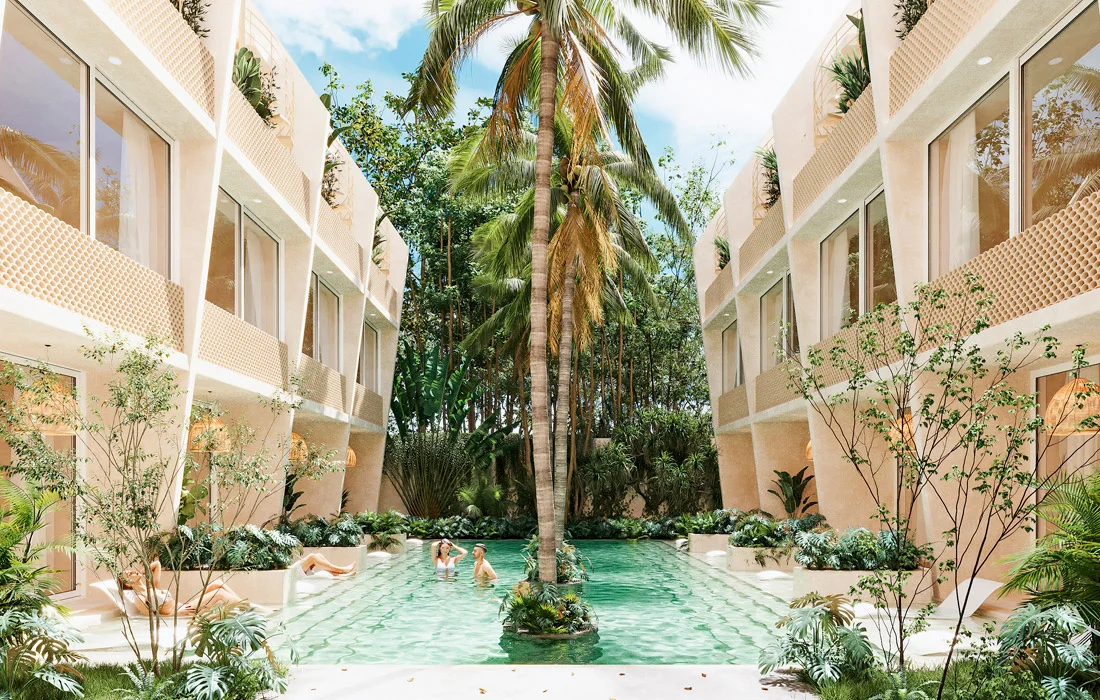
Hotel Zone: pros, cons and who it is for
The Hotel Zone fits if your life fits beach, hospitality and tourist services, and you accept noise, tourist-zone pricing and less "city" at the door. It does not fit if you want a local market, a school on foot or neighborhood quiet. It is one of the best areas to live in Cancún only for a specific profile, not for anyone who wants the sea.
Clear pros: Caribbean access without a long crossing, restaurants and leisure, buildings with resort amenities, and a rental market that understands visitors. If your job is in a hotel or strip services, the commute shortens.
Clear cons: the pace does not fully drop in low season. Blvd. Kukulcán is a transfer road, not a town street. "Resident" groceries often mean leaving or paying a tourist ticket. Neighbors rotate: guests, hotel staff, investors who do not live there.
Who it is for: people who work in the hotel zone, singles or couples without a daily school run, anyone who ranks beach over errands, or anyone who uses the condo part of the year and operates it the rest (if the rules allow it).
Who it is not for: a family that needs school, a regular clinic and a city supermarket; anyone who wants quiet; anyone chasing "cheap Cancún" on the first line.
Noise, services and the usual ticket
Noise in the Hotel Zone is not only the party. It is boulevard traffic, deliveries, lobby music and seasons when the strip does not sleep. A high floor toward the lagoon is not the same as a low floor toward the avenue. Ask for amenity and construction hours, not only the rooftop photo.
Strip services are built for the guest: restaurant, spa, tour, convenience store. A resident also needs a hardware store, a clinic without a hotel appointment, and a supermarket that does not charge a tourist menu. That exists in the city. In the hotel zone you often replace it with an app and a taxi.
The usual ticket (buy or rent) sits above Centro by meter and by "beach brand". There is no official price we can cite. What you can compare, unit by unit, is the maintenance fee, a reserve for climate and humidity, and whether the building lives off short-term rental. An "attractive" entry ticket with a resort fee and vacancy in September is not a bargain. It is a different math.
If the ad promises "beach investment and guaranteed appreciation", bring it down to rules, real occupancy and costs. We do not publish Cancún yields because we do not operate them.
Puerto Cancún and newer residential belts
Puerto Cancún and the newer residential belts fit if you want access control, amenities and a more residential setting than the hotel strip, and you accept fees and commute. They are not "cheap Centro" and not "beach at the door". They are Cancún residential areas of planned product: marina, club, tower or house in a gated community.
Puerto Cancún, to the north, is sold as a city inside the city: marina, retail and housing with rules. It fits if you want access control and a more closed setting than the strip. Daily life can be more predictable than on Kukulcán. The cost of that order usually shows up in maintenance and in the neighbor the product seeks. Again: no list price. Ask for the fee, pet and rental rules, and what happens if the internal retail does not cover your groceries.
Costa Mujeres also shows up in "living in Cancún" ads to the north. It is another coastal belt, not Centro and not a supermanzana. Treat it as a beach-and-commute product, not a neighborhood for daily errands.
Farther south and west, belts the market calls new residential areas keep growing. Huayacán is the corridor most often named for families: plazas, schools and gated housing, with more car than beach on foot. Polígono Sur is recent expansion, often closer to the airport, with services still under construction. Cumbres and Álamos are the other type: an already inhabited subdivision, less "render" and more school week. We do not list them as a ranking. We list them as a type: more housing for people who work in the city, less postcard. A new street can have a tower and no clinic or dense transit.
Useful questions in these Cancún residential areas:
Does the development already have neighbors, or only a render?
Are water, sewage and internet from the grid, or a patch?
Are school or work on your side of the city?
Does the gate isolate noise, or does it only add a booth?
Anyone who wants calm and control usually looks here before the hotel zone. Anyone who wants to walk to the market and to errands usually goes back to Centro.
Cancún Centro and local daily life
Cancún Centro is the option if your life is city: supermanzana, avenue, market, errands and a job that is not in a lobby. Living in Cancún as a resident, for many locals and for anyone who moves for work, happens more here than on the strip. The beach is not on the corner. The supermarket is.
Local daily life looks more like a mid-size Mexican city than a resort: combis and buses, plazas, offices, urban clinics, and avenue noise different from Kukulcán. There are quieter supermanzanas and busier corridors (Bonampak, Náder, Tulum). "Centro" is not one street. It is a mosaic. Walk at night and at rush hour before you sign. Náder is sometimes sold as a "top colonia" for leisure and downtown proximity. Use it as a corridor, not as a promise of quiet.
Pros: less tourist pricing than the hotel zone, access to public and private city services, and a life that does not depend on cruise season. Cons: beach as a plan, not a walk-out habit; internal traffic; and buildings that differ a lot (from everyday housing to a new tower). The ticket is usually lower than Puerto Cancún or the first line, but "lower" is not an amount. It is a relative position.
Who it is for: people who work in the city, people with kids in an urban school, anyone who does not want to pay resort prices to sleep. Who it is not for: anyone who needs the sea every morning or anyone who thinks "Cancún" is only the strip.
Connectivity: airport, work and beach
Cancún's connectivity is its edge versus other destinations in the state: an international airport, a grid of avenues and a hotel strip that concentrates tourism jobs. It is also the cost: the same map that connects you jams you if you pick the wrong stretch.
Cancún International Airport (CUN) is operated by ASUR. In the Cancún International Airport (ASUR) contact details the published address is Carretera Cancún-Chetumal Km 22, Benito Juárez, Quintana Roo. That puts the terminal south of the city, not "five minutes from any colonia". Anyone who lives toward the south or uses the Chetumal highway has a different access than anyone leaving from Centro or from the north of the hotel zone. The clock is traffic, not the pin.
Work: hospitality and services weigh on the strip. Offices, retail and government weigh in Centro and on the avenues. A new residential can look "close to everything" in the brochure and sit far from your real job.
Beach: the strip gives access. Centro and many gated communities give a transfer. If your idea of living in Cancún is swimming when you wake up, do not choose only by school. If your idea is school and supermarket, do not choose only by the boardwalk.
Before you buy, drive the home-work-beach triangle (or home-school-airport) three times. If one point always hurts, that area is not "better". It is the wrong one for you.
Family, services and noise
For families, the best areas to live in Cancún are usually the ones that combine school, clinic and a setting that does not live off the tourist night: consolidated Centro, already inhabited Cumbres or Álamos, or the Huayacán corridor if you accept a car. The hotel zone can work for a couple without kids or for short stays. As a school-week base, it needs more filter. There is no official map of the "safest area". There is street, lighting, short-term rental rules and a night visit.
Family noise is not the same as club noise. It is 7 a.m. traffic, tower works, and short-term neighbors on the weekend. In Centro the risk is avenue and retail. In a new gated community the risk is that today's quiet is tomorrow's construction. Ask for the build calendar of the lot next door.
Services: a family needs more than a pool. It needs repeatable groceries, a regular doctor and a rain plan B. That shows up sooner in the city and in already inhabited residentials than in an isolated tower with a gym.
Schools, hospitals and life outside the resort
Everyday schools and hospitals are mostly in the city and on urban corridors, not on the beach kilometer. IMSS publishes units in Cancún in supermanzanas and on avenues. The state government has announced hospital conversion works in the city. That describes system supply, not a "best hospital" ranking or a wait time.
We do not list private schools or brand clinics. They change address and the right check is your visit, not a blog directory. If you have kids, ask for the school route at rush hour. If you have regular treatment, ask how you reach your specialist on a Tuesday, not a Sunday.
Life outside the resort is exactly that: market, park, errand, a neighbor who does not leave on Sunday. Anyone who only knows the hotel zone often discovers Centro when they need a prescription or a certificate. The other way around: anyone who only knows a supermanzana discovers that "going to the beach" is a traffic plan. Choose with both maps open.
A condo in Cancún versus other Quintana Roo destinations
A condo in Cancún does not compare well with one in Playa del Carmen or Tulum if you only look at "Caribbean" and square meters. Cancún wins airport and tourism-job mass. Playa concentrates a walkable city and Quinta Avenida. Tulum mixes town, jungle and a shorter hotel zone. The product (lock-off, gated community, oceanfront tower) changes by destination.
Condo in Cancún: more perceived liquidity from visitor volume and from CUN. Also more supply and more market noise. The risk is not "that there is no tourism". It is buying resort pace when you wanted a neighborhood, or a neighborhood when you wanted beach.
A condo in other Quintana Roo destinations: less air hub at the door, another occupancy calendar, another kind of neighbor. In Tulum, from what we operate, the 12-month habitability filter (humidity, power, town vs beach) weighs as much as the rental filter.
If your goal is to live, compare a typical week. If your goal is to invest, compare use, rules and operations, not the destination slogan. Condos in Cancún are not "better" by default. They are different. The expensive mistake is signing the destination after a vacation week and the building after the render.
If you want developer product in the state
If after this comparison you want developer product in Quintana Roo, the next step is not "look for a Cancún condo in the Menotto catalog". We do not have one. We operate housing in Tulum and the Riviera Maya. The filter we can support is residential for real use: location, stage, rules and whether the unit can be inhabited, not only photographed.
To see typology and stage, start with the 1-bedroom condos at Reverence Tulum. The catalog of residential developments in Tulum groups other stages and sizes. If your question is fit (family, rental, delivery), use the availability consult with Menotto Group. A call does not replace your Cancún-area checklist. It does keep you from mixing a Kukulcán resort with a town home in Tulum.
FAQ
Frequently asked questions
What are the best areas to live in Cancún?
The best areas to live in Cancún depend on your week, not a ranking. The Hotel Zone brings beach and tourism closer. Puerto Cancún brings planned residential. Cancún Centro and corridors such as Bonampak or Náder bring errands and jobs closer. Huayacán and Cumbres are the family type named most often, with more car than sea at the door. The "best" one is the one that matches work, school and the noise you accept.
How advisable is living in Cancún year-round?
Living in Cancún year-round is advisable if your motive is a city with the sea nearby, an airport and service jobs, and you accept heat, humidity and tourist-destination traffic. It is not if your only reference is a hotel week or if you need town quiet. Test a high-season stretch and a slower one before you sign.
Which is the most expensive area to live in Cancún?
There is no official amount. By product type, the Hotel Zone and Puerto Cancún usually sit above Centro in ticket and fees: they are also the ones the market calls more exclusive. "More expensive" does not mean "better to live in". It means more tourist meter or more amenity. Ask for the price and maintenance of the specific unit, not an internet average.
What are the best colonias to live in Cancún if I have a family?
For families, the best areas to live in Cancún are usually consolidated Centro, already inhabited Cumbres or Álamos, or Huayacán if school and supermarket sit on that side. The hotel zone fits a school week worse. Do not use "best colonias" lists as a title deed. Walk at night, measure the bridge and ask about short-term rental rules.
Is the Hotel Zone or Centro better for living in Cancún?
Hotel Zone if your life is beach and hospitality. Centro if your life is city. Neither is the best place to live in Cancún in the abstract. If you mix a job on the strip and a school in a supermanzana, the commute will charge you the "average". Choose the end you use five days, not Saturday's photo.